Rhéa Hleihel is a multihyphenate, plurilingual literary artist and emerging media performer, available for creative collaborations across poetry, spoken word, video, music, language, and cultural projects. She focuses on identity and transformation.
Named after Rhéa, the Greek Titaness associated with origin, motherhood and renewal, she writes from a place of movement, intuition and cultural depth. She belongs to a vanishing breed of master writers and wordmakers.
Having travelled to more than 50 countries and lived in five beyond her own, Rhéa brings a visually sharp and globally attuned sensibility to her work. Her writing is shaped by Eastern cultures, particularly Thai, Japanese, and Chinese traditions, and by a deep interest in the rituals, aesthetics and emotional codes of the places she encounters.
Her poetry, essays and editorial pieces explore darkness, taboo, rebirth, desire, womanhood, queer culture, GL narratives and the politics of self-definition. She is drawn to what society represses and transforms forbidden truths into language, beauty and authority.
Fluent in French, Arabic, English, Spanish and Latin, with knowledge of Japanese and Thai, Rhéa moves between languages and cultures with nuance and curiosity. She writes against inherited shame, social conditioning and the instincts that keep people from living freely.
Her voice is rebellious and expansive.
Work
In parallel to the artistic work, much of Rhéa’s work unfolds in luxury and high-culture environments.
She currently serves as an adviser for the Ministry of Culture in Saudi Arabia. She has worked with institutions including the Saudi Tourism Authority, Buro Happold, Dar Al-Handasah, the World Bank Group, AAA Architects, And_Us Agency, Centdegrés… She has interpreted in conference settings for senior government officials in Saudi Arabia.
Rhéa received her PhD with honours from Saint Joseph University in Beirut in Translation Studies and has taught writing, translation, and theoretical knowledge for more than a decade. She has delivered keynotes and lectures at institutions including the Mohammed Bin Salman Foundation (MISK), the Lebanese American University, the Islamic University in Lebanon, York University (Toronto), JECRC University (India), ESIT, ISIT / Paris Panthéon-Assas, the University of Alicante, and the International Translation Forum in Saudi Arabia.
Her articles have appeared in peer-reviewed journals including Meta, Lebende Sprachen, and Forum.
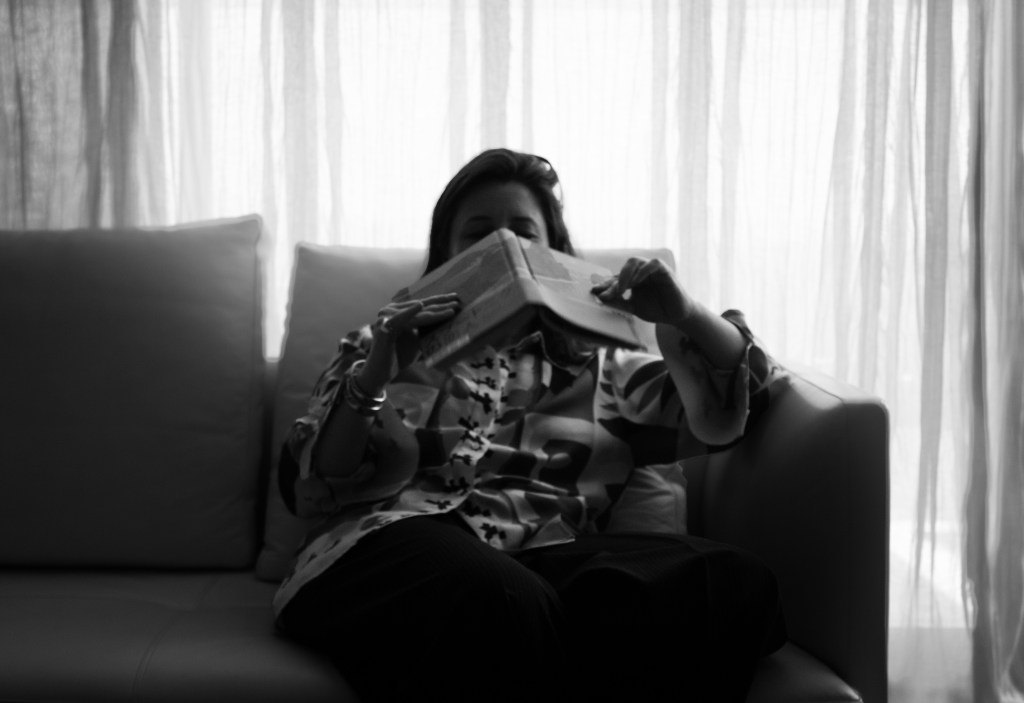
Up Close & Personal
What are the beliefs that shape who you are?
Having grown up in a cult, I reject religion, and have always been drawn to what society represses. I am drawn to mythologies, ancient rites, the otherworld, and Death. After all, I am named after the Greek Titaness, mother of all origins. I have written about absence and death more than any other subject.
I like to believe that we exist in infinite lives beyond this one, in multifaceted realities of multiple intertwined universes.
I always wonder—what’s beyond this life, where do we go, what happens to all of our emotional investment and if ever we meet our beloved beyond this world. In a way, I constantly search for the red thread and the alternate reality of the world.
How does Beirut inspire you?
I grew up in Beirut, a city of contradictions, a city that loves summer, but I haven’t always lived in Beirut.
I used to drive to Achrafieh, one of Beirut’s neighbourhoods, and contemplate the antennas and cables protruding from the buildings. I found the cranes hanging atop the construction sites endearingly inspiring. I used to take the longest detours to see the port’s cranes, that looked like giraffes and dinosaurs.
I love urban landscapes, rubber wires, the city, its skyline, laundry fluttering in the wind, especially at dusk and a little later.
What was your career like?
I began working for my professor who gave me poetry to translate. After that, I worked for a couple of local magazines and continued the freelance route.
Then I went to New York for an internship. After finishing my two masters, I got a PhD in Translation Studies. I felt I never belonged to the academic world, although I taught at university for more than 10 years. It felt too boxed for me—too rigid.
In all of that, I always saw myself as divergent from the world around me.
I’ve always been the other girl. The different girl. Fitting in was always and still is so hard for me.
What did it feel like to live in New York?
Too fast. Life is too short and I like to stop and see the world.
What was a meaningful stop for you?
My research residency in Montreal, where I survived the endless winter, as the residents call it.
During my stay, I put to the test every notion, concept, and idea I believed in or was convinced of—among them, the notion of cold. Everything suddenly becomes relative when it comes to staying in a place called Home.
I walked the streets of Montreal a thousand times over, in the biting cold, without ever complaining (my friends complained a lot!). The metro lines, the underground cities, people’s faces, even the snow and black ice covering the alleyways, became familiar aspects of my life.
A year after my departure, Montreal was still Home—a place of longing and belonging. And where chance chose Beirut as the city where I was born and raised, my heart and mind back then chose Montreal.
The Portuguese call this feeling saudade. It is a deep, intensely emotional state that carries an infinite emotion toward what once was—but that, probably, will never be again. An unspoken nostalgia of some sort.
I never desired to go back.
Where do you see yourself living in the near future?
In SEA, Bangkok, Tokyo, Taiwan, Shanghai.
Your favourite animal or mystical creature?
Orcas and dragons. They appear frequently in my poetry.
Ironically, my favourite creature has always been the dragon. I never understood why, then I went looking for the inner Rhéa, and I found out I was born in the year of the Chinese Dragon and the Thai Nāga (พญานาค).
A lot of my character comes from this, I noticed.